Thursday, August 12, 2010

Sangorski and Sutcliffe binding


The history of those two is well known....if you dont know, they were two young guys who went to the Central school of arts and crafts(later st martins and the London institute), completing a bookbinding program in the late 19th century.They both won scholarships allowing them to continue their training for 3 years, before going to work for Douglas Cockerell.

bookbinders genealogy

They started their own bindery in 1901, and have remained the most well known pair of English bookbinders.....and heres why......

Their jewelled bindings.....the peak of which was the famous "great Omar" which went down with the Titanic in 1912.

I was lucky enough to get to leaf through this binding of a selection of Henry Wadsworth Longfellow's poetry , with hand calligraphy on parchment by Sutcliffe himself. The book has many  similarities to the Omar, in design , technique and execution.There are many bindings you can look at it to remind a bookbinder of his or her place in the universe, and this is one of them.

Bound full blue morocco, precious stones , cut mother of pearl , surface gilding , gold tooling , and countless onlays.

The doublures feature a cosway-style miniature of longfellow , again with the same tooling , and a leather fly so thin that it is almost impossible to conceive of how they could achieve that back then , machined or otherwise...again decorated with onlays and gold tooling.The binding was not dated, but is signed by Sutcliffe in the colophon

Woe be unto any Bookbinder who doesn't know what a Cosway binding is... you might be the victim of an aerial food stuff assault.

It is interesting to note the similarities between this and the great omar - aside from the materials and techniques - the persian motifs of design, gilded floral designs built around the main structure of ovals, inside and out.

Coming face-to-face with bindings like this is a rare treat for me, and a great opportunity to gain insight into how they were made.....the point size of the tools , the construction of patterns from hand tools, the thickness of the skin in different areas, the construction of endpapers and leather joints etc....


tom conroy's "english bookbinders.." volume 14 no.1 circa 1990 
Etherington and Roberts ...dictionary http://cool.conservation-us.org/don/dt/dt0856.html 
Cosway bindings   Bibi Mohamed   see article for further reading list

Sunday, August 8, 2010

La fete de boites continue....


Yes thats right...more boxes....a selection of the latest includes my 3rd gravity's rainbow,and  a box for a signed Hemingway.


The Hemingway title is stamped, as there were 2 editions(both boxed),and the lower case type was requested for this.

Other than that, all of the boxes since the middle of 2006 are hand-lettered.That is not to say that I have not used plates to stamp onlays..more about that later.I avoid it as much as possible, because it can make the boxes look generic, but in those cases where there is a specific requirement to reproduce particular artwork, it is usefull


Printed onlays with regular and half-tone plates, taken from the dust jackets


Saturday, July 24, 2010

Strange and unusual


I made this book for architects in 2007, working for the estate of M.Knight Shayamalan,"Ravenwood".
As is often the case with designers, they brought a specific material that they wanted some how to incorporate into the front and back boards.
Now, there are many ways to communicate a gothic atmosphere or feel, especially around the suggestive name "Ravenwood", and as a binder I would have done it completely differently.
However, sometimes you have to give your client what they want, and work with what your given.
In trying to solve the problem of using the material(feathers glued to fabric), in a way that looks finished,you can learn some stuff along the way too.
The main problem was the thickness of the feathers, and the fact that it was impossible to use as a regular fabric, ie , turning it over the board.So I decided to recess the material.
The next problem was that simply recessing the material, would not solve the problem of the exposed edges of the fabric, which was mainly visible along the top edge, due mainly to how the feathers were mounted, like tiles.
SO, I made a framed split board, holding the mounted feathers....it took some time, the area of the frame closet to the feathers is unglued which presented its own difficulties.
I'm filing this under a new category "Strange and Unusual", along with the
books hiding a mechanism for a secret door , and  3D book Sculpture in 2008.
Im sure they won't be the last...

Friday, July 23, 2010

CFDA's Annual Vogue fund


The CFDA and Vogue magazine run an annual competition for young designers within several disciplines working in the industry.The fund is designed to mentor designers that have demonstrated exceptional talent and, "capacity for future distinction".The winners and runners-up are awarded substantial monies for the further development of their work
The candidates must submit a portfolio , or look book showcasing their collection or body of work, which is where we come in .
Since 2006 PDB has made portfolios for the following candidates, finalists , runners-up , and winners..


All work presented challenges, as all the designers quite naturally wanted the book to reflect their work.There was creasing, filling , using silk-screened fabrics , book box constructions with a hollowed out well for a model heart , and complicated recesses for jewelry fashioned from epoch old mammoth bone recovered and sold by inuit tribes, including a book this year , made with buckles and straps.Work ranged from basic case-bindings, to more complicated 3 piece bradel bindings, to full leather bindings.
I would also like to thank Roanne Adams and her team of designers , who worked with me to produce some good work, and hope we can do much more..
 
We've done a lot more unusual stuff since 2006, but that will be another post....

Friday, May 28, 2010

Craftsmanship on Govenor's Island


It was a great event, the show will remain open to the public on the weekends through June.
I've included a link to the site , and the pictures came courtesy of Mindy Belhoff at Intima Press


http://artofcraftsmanship.com/artisan_dovey.php


Sunday, May 23, 2010

Wrenching Times - finished


My first design binding since 2004, and my first one that is match ready!

Binding in black goatskin, unsupported french link with secondary sewing.
Inays of dyed goat, printed with half-tone images taken from the library of congress depicting iconic images from the american civil war.
Tooled lines in black across the exterior and interior of the book in the form of crucifixes.
Hand dyed and printed ends and doublures, again depicting intimate portraits of the the true, sometimes overlooked and personal cost of conflict.


The book is part of a larger exhibition on Governor's Island , in conjunction with LVMH and sponsored by the New York Times, and will be open to the public during the month of June.


Details to follow......

Friday, May 21, 2010

The Marquetry and bindings of Alain Taral-le deuxieme jour!!


So I was lucky enough to sit in on visits to the Metropolitan Museum, and the Morgan Library , with Alain Taral and Laurence Fayard.
Mindy Dubansky was gracious, considering the recent upheaval of rennovations to the conservation dept.,and totally engaged with the work.Mindy has worked at the Met for 27 years, and in so doing has an extensive knowledge of collections, history, and art. The meeting was informative, for me anyway, because I got to learn about "xylothek" for the first time,  or wooden libraries, an example of which can be found in germany, and which she was able to print out some information on the spot.
If you want to know more...here is the homework.


wooden library


Alain also demonstrated his limp veneer bindings, where movement was obtained in the veneer, by cutting strips and laminating them side-by-side,at which point Mindy made the very clever point that in his strips, and hinges, Alain had managed to bring flexibility to material that does not naturally have any.
The staff were suitably impressed with his work, Jae Carey was particularly pleased in light of her recent studies over the years of the piano hinge


The photograph shows an animated Mindy talking of xylotheks!!

Next came a trip to the Morgan Library, where again I was lucky enough to tag along, any excuse really to see the fabulous facilities in the conservation dept., and also the Magna Carta in Mr.Morgan's library, complete with silk walls, and secret staircases!!!Maria Fredericks was able bring an historical context, by showing an example of a renaissance(perhaps Maria could offer some clarification on that later)illuminated book, that had a later metal binding, complete with metal hinges, that worked in a similar fashion.Interestingly, the book was attached by means of a metal rod laced through a hollow in a fabric covering at the spine.

Both visits brought a closer critical understanding of how the bindings work.The book is essentially sewn on tapes, no adhesive is used on the text-block, and the book is attached to the binding by means of suede flap, wrapped around the binding(not glued to the spine),and glued to the fly leaves of the endpaper.The suede is then able to be glued to the solid wood spine, leaving a hollow when the book is flexed.
Thankyou to all who were able to take part.

Thursday, May 20, 2010

The Marquetry and bindings of Alain Taral


It was my good fortune recently at the Grolier club in town, to meet among others the winner of the 2009 International Bookbinding competition, Alain Taral.It was my further good fortune to arrange a meeting at the bindery today through his student, artist and interpreter Laurence Fayard.After studying with Alain, she is learning more about bookbinding, and working on startin up on her own in 2011.
It was a great opportunity to see a completely different style and approach to binding, and its always nice to meet other binders anyway.
Alain started binding in Toulon in 1989.A client had asked for a binding using wood, and so began his career, perfecting his solid wood, and veneer bindings, complete with the most exquisite inlaying and marquetry.

Its all about the hinge...a kind of piano hinge built around metal rods, or pins.
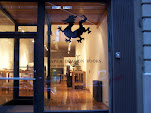
He first produced a small box, with the first incarnation of the hinge...this he said was suitable for making boxes for documents that were not be touched.
The second incarnation is the hinge style he uses for design bindings, impressive still.
The third hinge , was truly a marvel...double hinged with 2 pins per joint,and butterfly clasps, giving the opening a kind double-jointed action.This example was reserved for special bindings for important conservation work.
We talked for 2 hrs at great length about all kinds of stuff !....the one thing that did stick out , was his statement that he had know idea why???leather became so popular and wooden bindings faded, and that it would seem counter-intuitive.
It would seem, the arc of bookbinding archaeology may be reversing, and some would say, that wouldn't necessarily be a bad thing.


A link is included for his winning binding, and the show is open to the public...you should all check it out.

http://www.designerbookbinders.org.uk/competitions/dbibc/international_competition.html

Wednesday, April 21, 2010

A Bookbinder's guide to Survival - Casebinding


The posts under these headings, are not intended as detailed instructions, but more as an overview of the work experience at PDB in the the first 4 years of its operation.Thats not to say there won't be detail, just don't look for it.Nor are they intended to be final, as I hope to add as I go on.


One of the first things you learn as a bookbinder is the simple, versatile and ever ubiquitous casebinding.You may learn the full, 1/4, and half cases, if you are lucky enough to work in a trade bindery you may even learn how to make a living at it.You will probably be taught how to sew sections, maybe even a different endpaper to the simple codex, but what you won't learn..........is how to bind single sheets.
If you can't find a way to deal with single sheets, you will starve!The method we use has not changed since Arthur Johnson detailed it in his manual.You will not always get sections(very rarely),so you have to know when to stab-sew, and when to overcast.The right sewing in combination with the right paper can produce good results.Recent developments in graphic applications have made it easier for pagination in sections, but the limited size of digital printers means this will remain a problem for the foreseeable future.
In making cases it is imperative to remember what I will now refer to as "Arthur Johnson's Golden Rule"..which came in the form of a question he was fond of catching people out on:
"What are endpapers for?"...a simple enough question for the young case binder, who replying with gusto would retort "well, they keep the book in the case", belying his limited understanding.
The answer to this most basic of all questions unlocks a fundamental understanding at the core of bookbinding.
"NO! they are to counteract the warp of the boards"...i guess there was more to binding than cases!
This basic knowledge is seen at work in casebinding.If you want to glue out with a paste/pva mix, giving you time to do the other side and nip in the stack, you must make the cases using the same adhesive, or the resulting warp will demonstrate the lack of balance!
I have learned that at the Wyvern Bindery , and at Blissett's both in london, an experienced casebinder can make 25 cases an hour , and case-in a book every 30 - 60 seconds(thanks Nick!).Multiply that by what you may charge, and ask yourself is there a more cost effective, and profitable item a bookbinder can produce.Now no one here is suggesting you should aspire to make casebindings for the rest of your life, but knowing how to do them, and do them efficiently, could save your life....or at the very least pay a few months rent!


Pictured, is a recent 3-piece, split-board case binding I completed for architect Santiago Calatrava.The size and weight of the paper all lend it self well to stab-sewing, ensuring a strong binding, some throw-up, but pleasant enough due to the landscape format.

Sunday, April 11, 2010

The Box Challenge - coming attractions


The Third Man......and Killer Angels
yes more half-tone printing, and more civil war
keep watching....

Friday, April 9, 2010

North Bennet Street School


A highlight at work yesterday was a visit from Jeff Altepeter(far left),  and the bookbinding students at the North Bennet Street school.These guys have been all over London, and now New York, visiting Bernard Middleton, my old teacher Mark Cockram, Shepherd's, The Morgan Library, The Butler room at Columbia, and the Academy of Medicine in town.
What a truly varied cross-section of Bookbinding life they have seen in the past year....
Not sure how the humble operations at PDB measured up, but as always I did my best to be both honest and generous, which I think is important.
Knowing that the full time course I attended at LCP in London was taught by 4-5 full time bookbinders, Jeff Altepeter can be truly said to be a one man army, undertaking a task like that pretty much single-handed!!!
You'll find a link to the school and its programs on the right.

Sunday, April 4, 2010

A Bookbinder's Guide to Survival.


Looking back on a particularly tough week of work in the bindery, I was struck by the many different directions I was pulled in, thanks mostly in part to the notable abscence of Enrique Perdomo, AKA in the right circles, as, "The Master Craftsman".
The work load had doubled in quantity, and diversity.There was some repair work, some period binding, some commercial presentation work, some large 3 piece case bindings with boxes and slipcases, all against the constant backdrop of full leather clamshells and their accompanying design work and printing.
With this in mind I will set out to clarify what have been for me over the last 4 years, and what I perceive to be, the fundamental skills required of a bookbinder in order to stay alive in a hostile environment.
I realise that this will be an entirely subjective point of view, but I will offer it anyway, as I know some of the lessons I have learned will be of use if nothing else to many (I hope!)young and aspiring bookbinders.
There will come posts on subjects such as repair, rebinding,boxmaking,and case binding in which I will attempt a frank account of the work completed at PDB, and point to what I believe are the relevant practicalities in trying to survive on your own in the trade.
This account will I hope serve to inform those thinking of making a living as a bookbinder, as to what they can expect.

Tuesday, March 23, 2010

The Art of Craftsmnaship Revisited, NYC 2010


LVMH working with students from Parson's school of design, launched a major project to bring attention to some great work that may sometimes go unnoticed by the skilled artisans and craftsmen working under everyones noses in the 21st century city of new york.
Students have followed me and my work on "Wrenching Times", and have created a fashion item based on their experience and interpretation, at the bindery....it sounds a bit garbled, but for now I will post this link to a candid interview which may go a long way to explaining the who, what , and most importantly , the why of paper dragon books.
There will be pics and a show to follow on govenor's island in june.

Interview

Friday, March 19, 2010

Box Challenge 2010 - the reckoning......


This year the challenge is to triple last years production.
This is the next thirty, and you can expect to see more inlaying, and scarf-jointed leather techniques, more printing on goatskin such as the rather successfull half-tones, aswell as the usual labour intensive onlays and tooling.....and possibly some linked-spine designs.
Design work should start in earnest at the beginning of april, and next 2 weeks will be taken up making the boxes and completing most of the printing.


I will take this opportunity to draw attention to the fact that the blog has had it's first birthday!
It was began mainly because we were having trouble with the web-site(not updated in the last 3 years), and we primarily needed to be able to show new work.

I have made a concious effort to lay bare as much as possible, my working practices, making them available for those who are interested, in a candid and accessible attitude. Thank you to those who follow and take part for their encouraging support and interest, it is hoped that the information has been useful to some.
I never imagined this to be an re-invention of the wheel, but in it's own humble way it has proven to be successfull with a modest 10,000 views.

 2010 is already off to a great start at paper dragon books, and promises to be chock full of new and interesting work ahead.

Also, after a 3 year hiatus, I will be teaching again at New york city's Center for Book Arts...Islamic binding, monday nights july through september.
best
g

Tuesday, February 16, 2010

S.P.E.C.T.R.E


 I was contacted by "C".They needed me to make  false books, around 2 wooden blocks for use as "levers", which when pulled from the shelf as shown, facilitate the opening of a secret passage way, leading from a library to a secret office.
All I know is, is that its for a private client at an undisclosed location in nevada.
I will try to obtain footage of its operation, but it will not be easy.