Saturday, January 23, 2010

Wrenching Times....halftone on goatskin


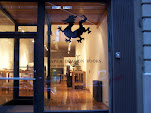
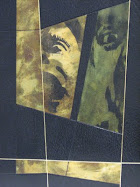
...more time with Mindy, at her studio in union square, printing the third half-tone polymer plate, on her vandercook Uni III(it has an adjustable bed)which she recently repainted.
The results were great, the softness of the skin proved very suitable for this style of printing, giving a rich deep inking, but not overly inked, picking up every detail and subtle contrast, that maybe is more difficult to capture on a paper surface.
The vellum did not come out that great....here's a tip, if you are going to print on vellum, do not over colour it, a half-tone print will be too subtle to make out.
...having my options limited in this fashion will help me move forward with the design.
Forwarding continues

Thursday, January 14, 2010

Wrenching Times ...flattening vellum


...so I'm not sure if it'll work, so the back up is to use a dyed fair goat...but the plan is to flatten old vellum sheets, print on them with a third plate which will be a famous image from the aftermath of the battle of Gettysburg.
The vellum is bathed in a solution mixed with alcohol to kill off all mold and nastiness.It then can be rinsed, dried, then dyed to suitable colour.
On the vellum skins, usually the side with the writing on is what would be called the "hair side" and the side most suitable for colouring.
I happened to have a hollow frame handy, and nailed the skin tight over the frame.I'm betting that it may take a week to dry.
I did also make a smaller, more finished frame, which consisted of a system of bull dog clips tied to nails.
This worked well and would be a good method for important smaller documents where more care would be needed, but in this i didnt need to be too precious.
Forwarding continues.....

Tuesday, December 29, 2009

Wrenching Times (design binding part 1)


....my first real design binding in a while, and some real meat to sink my teeth into.


 "Wrenching Times"- a selection of Walt Whitman's civil war poetry from "drum taps".
Printed by Gwas Gregynog Press, in 1991 - 20 years ago !! - and masterfully illustrated with wood engravings by Gaylord Shanilec.


5 years of a steady diet of ken burns, david mcullough , et al...I'm ready to give it a go.


First, the ends, constructed in a variation on no.13 of Arthur Johnson's Thames and hudson manual.

The idea was to capture something of the essence of the book, and thereby set the design off on the right footing, giving the binding a heart around which the rest of the body is built.


I came across a photo archive in the library of congress available for viewing and reuse by the general public, and then found some very famous images from the civil war taken by pioneering photographers Thomas Roche, and Matthew Brady.(definately a usefull tool for the future- thanks dimmy)


The images selected, have been then printed on zerkal, from half-tone polymer plates, that have been cut-up prior to printing.
Then Monoprinted with wood veneer strips, and finally coloured with acrylics.
The idea with colouring was to obscure the edges and surrounding areas, and create a kind of pocket of light around the main image.  My thanks are extended to my new buddy, Mindy Beloff at Intima Press who helped me get the plates made, and for letting me use the studio to print. Mindy is a very knowledgeable letterpress printer and book artist, and she runs pretty cool classes out of her studio at Union Square. I have included her link in our friends of Paper Dragon Books on the right side.
Tone is set, the forwarding can continue.............

Tuesday, December 22, 2009

Happiness is....


...a warm pair of boots, and a full press!

We (and by we, I mean me and denise) would like to join with everyone to unanimously say...
"goodbye 2009, you will not be missed."
It's been a tough year for everyone, but for us ...lets just say all work produced this year was done so without the aid of heat.All I will say about that is that it is no fun trying to make books and boxes at 40 F.
Somehow we survived, and we all made it through.....2010 will be much, much better
I promise.

Watch this space over the next month, and you will see me make my first real design binding in years!

Wednesday, November 18, 2009

The Box Challenge - The Wall


...so the method is this.
take a title, and write down some ideas.
make drawings from those ideas.
re-draw or develop pattern or idea.
put them on the wall and choose.
Click on the image twice to magnify...blogger has made some changes..

Monday, November 9, 2009

The Box Challenge - Vanishing point


exercise..

The Box Challenge - pattern work


gouges,fillets and wheels....

The Box Challenge - a paris...


...this was fun

Saturday, November 7, 2009

The Box Challenge - Results - Round 2


....more boxes, and more to come.

Sunday, October 18, 2009

The Box Challenge - Surface Gilding


I don't know...it seemed appropriate and pretty easy enough to do .
French pale,rosenoble and fine gold.

Tuesday, October 13, 2009

The Box Challenge - results - round 1


As promised
The first batch of 10 from last week
...lots of onlays, tooling, handlettering,a bit of gold work , some eggshell and some printing =
2 days design work
2 days tooling patterns
5 days dying, paring,printing, and applying goatskins
5 days final tooling in gold and foils
...another fitzgerald...I was going for stained glass...

Friday, October 9, 2009

Eggshell panels (part 2)


Having sanded the panel to a smooth glass like finish, you can colour them and finish with a double coat of shellac(sanding inbetween , of course!).This can be then buffed to high gloss, on the book.
I coloured mine just slightly, using red, blue and yellow dyes.
I have worked panels into shapes and curves before, but it is a great deal of work, and requires different prep.,so while some may rightly think the design lazy....expediency is the key to getting the job done.
IE The Great Gatsby.....east egg .....west egg ..... eggshell panels.... job's'a gudden ....next!
The panels are cut on the board chopper, and recessed onto the case, then worked into a pattern of basic lines, black onlays, and a little gold.I apologise for the quality, I literally had minutes to take them.
This is one method of making an eggshell panel.There are others.....
I will be posting the results of the finished boxes , every 2/3 days...
To come...surface gilding.

Saturday, October 3, 2009

Box challenge Day 50..D-Day approaches...


So...the first batch will be out this week,and pics will be shown when finished....
It rained all day, while I was tooling, but the weather broke around sunset, and the light came raking in across the park lighting up my own tree silhouettes(more block printing..I will have start something new soon!)I took a picture... the top left corner of the view..It's not a mocking bird but it was out there.... all on its own!!
it was a good day
Part 2 of the eggshell monday

Sunday, September 13, 2009

Box challenge day 35 / Eggshell panels part 1


Jean Dunand(1877-1942) is credited with first using lacquered eggshell panels in furntiture and bindings.
I was lucky enough to be around to see one of my old teachers make a
panel, and consequently I have another trick I can use.(thanks Mark!) Glue the eggs on to
a rough black paper, grout it with black gesso, sand, and sand, and sand, until the surface is as smooth as glass, or thereabouts...
Part 2 will include colouring the panels , sealing with a lacquer, and mounting as a recessed onlay onto the cover for "The Great Gatsby".

Tuesday, September 8, 2009

Box challenge DAY 28


...now this is not the traditional box you will see many trade binderies producing.That box is made in 2 parts, this one is in 3.
Of course I think this box is stronger,functions better, and looks more polished.
Stress at the joints is divided by the form(inside joint) and the case(outer joint), rather than having 1 piece do all the work.
The head and tail are turned-in over a square vellum/goat head cap, forming a snug trap into which the form will be glued in.
I essentially treat the box as if I am casing-in a leather case binding.
That is, when "putting the back in", I set the joint with a backing board, and leave in a "fence" in order to keep the board at 90 degree angle to the form.
One word about the joints.....
I want to put the joints down with the board open at 90 degree angle to the spine...just as in casing-in a leather bound book.
The boxes left overnight to dry can be cased-in the following day,trays, joints, linings etc....
I have found that putting the joints down this way increases the flexibility of the box, whilst also relieving the tension at the inside joints.This will also prevent the boards from pulling off the spine and pulling the box open when cased-in and standing up.
Boxes with the joints put down in this manner, can be opened all the way backwards so that the foredges of the board touch with no danger that the joint will split.
Now no-one is going to be opening boxes like this, but the added flexibility is a bonus, and can only extend the life of the box.
NB ...also this is the last point you will have to make sure your boxes will stand-up straight, catch the ones that are going to be a problem and fix them.If you don't see it now, you won't discover it until the box is finished.....and thats never good!
so to recap....casing in this way will ensure your boxes stand-up straight and stay shut!!!
Which is what we all want ...basic requirement!